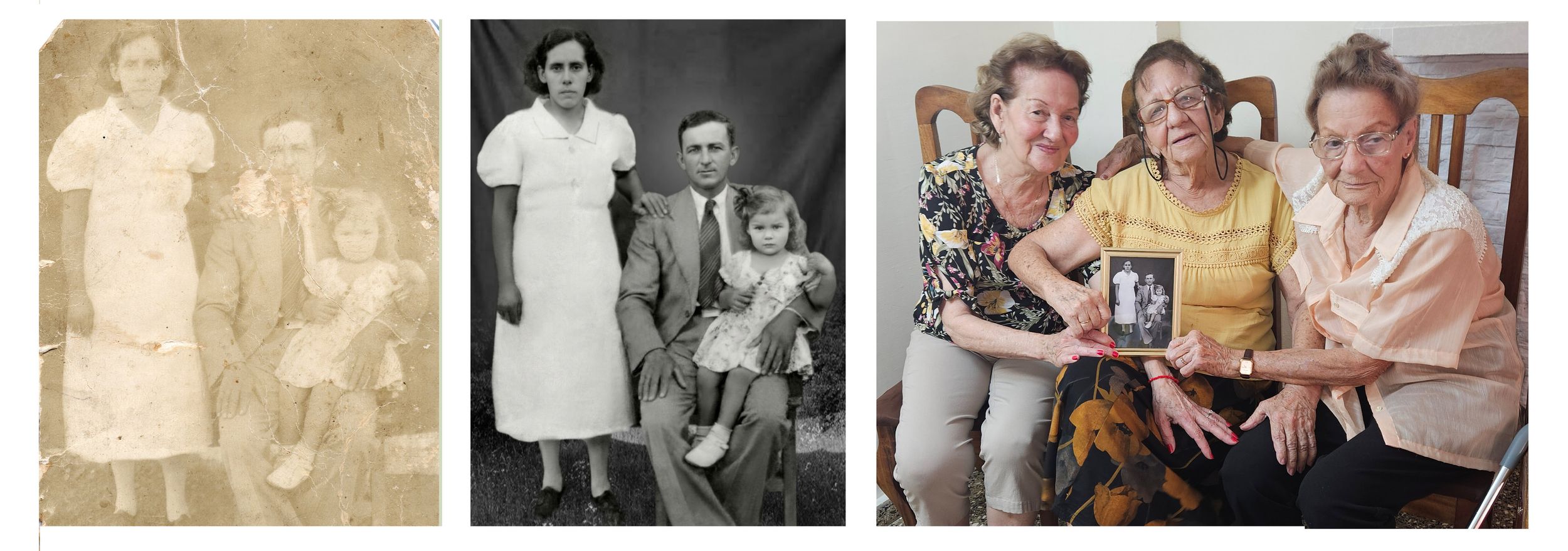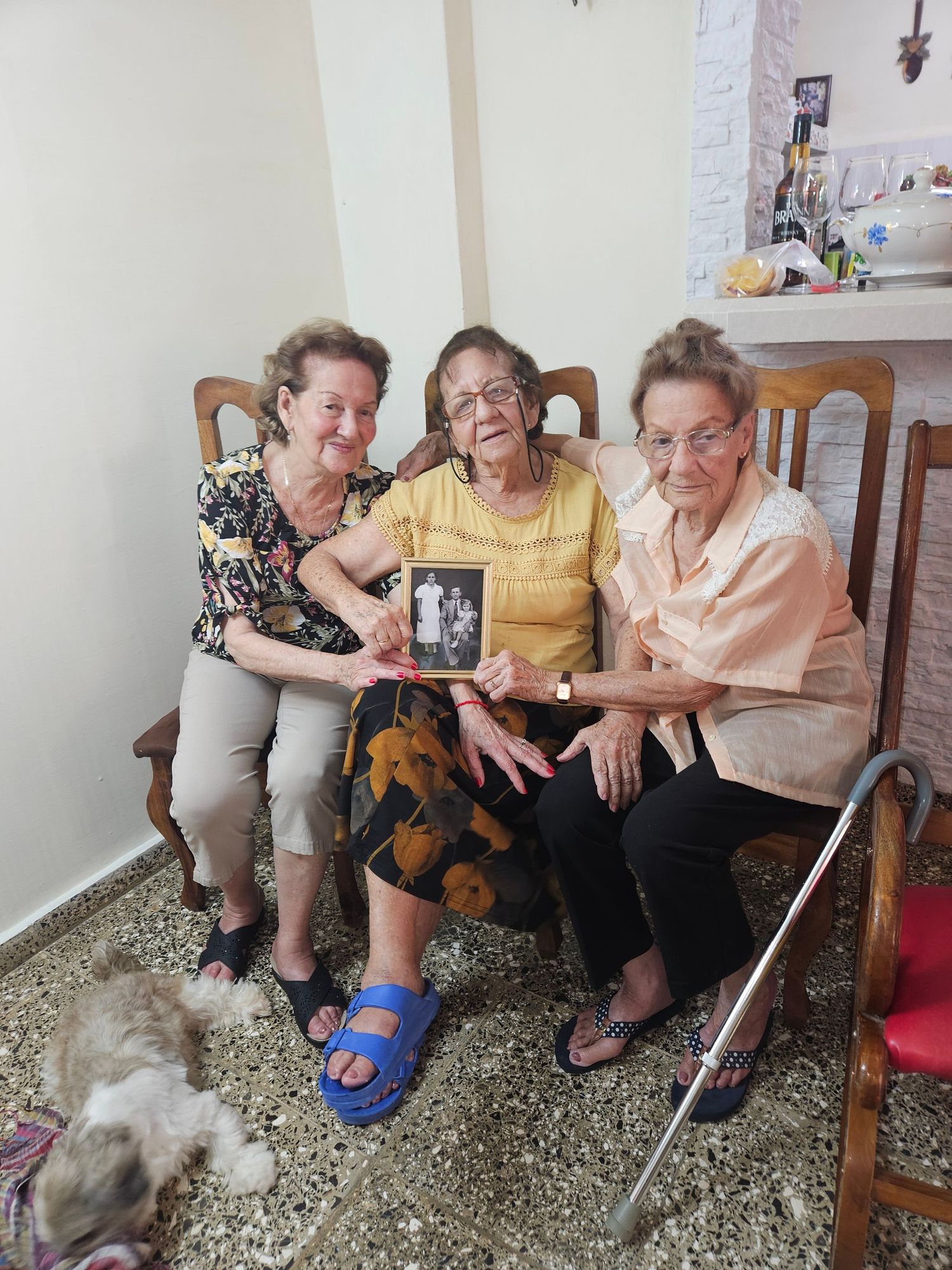
What the apps won't tell you, and what actually matters when a photo is the only one left.
Every few weeks, a new app promises to bring your grandmother's face back to life in seconds. You upload a cracked, faded portrait. The algorithm sharpens it, smooths the creases, guesses at the eyes. And for a moment, it feels like magic.
I understand the appeal. I really do. When you're sitting with a box of old photographs and the weight of wondering if these images will survive another decade, anything that offers a quick answer feels like a relief.
But I want to be honest with you about what that process actually does — and doesn't do — because the difference matters more than most people realize.
What AI restoration actually is
AI restoration apps work by making educated guesses. They've been trained on millions of faces and photographs, so when your image is damaged, the algorithm fills in what's missing based on what it has seen before. If your great-grandmother's eye is obscured by a scratch, the tool replaces it with what an eye typically looks like.
That's a technically impressive feat. But it's not restoration. It's reconstruction... and the distinction is significant.
The face that comes out on the other side may look like a reasonable version of the face. It may even look beautiful. But it won't necessarily look like her. The particular way her eyes turned down at the corners, the fullness of her lower lip, the way light caught her cheekbone: those details are either preserved or they're replaced with a statistical average. You often can't tell which until you compare the result to another photograph of her, one you find later, and realize the eyes are wrong.
Last year, one client came to me after her nephew had already tried. He'd meant well. When she mentioned she was looking into professional restoration, he said: why pay for that when AI can do it in seconds? So he ran the photograph through a tool and showed her the result. It looked good. Clean, sharp, believable, but when she looked closely, the people in the photo were nothing like her mother and father. The faces were plausible. They just weren't them. She brought me the original and I restored it accurately and she was very happy with the results.
What professional restoration actually is
Here's something I don't say enough: I use AI tools. Quite a few of them, actually. They're part of my process.
But the way I use them is fundamentally different from uploading a photo to an app and downloading the result. When I run a photograph through an AI tool, I'm extracting the best of what it can offer — a sharper edge here, a bit more detail recovered in the shadows there — and then I evaluate every single change critically because AI tools are not accurate. They guess. Sometimes brilliantly, sometimes in ways that are subtly, importantly wrong.
So after the AI pass, I go in by hand. Pixel by pixel. I correct what the algorithm got wrong, restore what it flattened, and make sure the face that emerges is the actual face in the photograph, not a statistically plausible substitute.
I'm reading the image the whole time, studying what's actually there, working with the information the original photographer captured, making decisions based on that specific person in that specific moment. I don't just accept what the AI gives me. I use it as a starting point and then do the work the algorithm cannot.
This is slow. It requires judgment about what to trust, what to question, and what to discard entirely. And it requires holding the photograph with reverence, understanding that this image survived for a reason, and that our job is to honor it, not to let a machine guess at it.
When a quick AI pass is enough
For casual photographs — a vacation snapshot from the 1980s, a slightly blurry birthday photo you want to share with family over text — a straightforward AI tool may be all you need. If the goal is a digital copy for sharing, and the original isn't the only one of its kind, the result will probably be good enough.
But most people who come to me aren't working with casual photographs. They bring me the last surviving portrait of someone who died young, or the only image of a grandmother who stayed in Cuba when they emigrated and left everything behind. They bring photographs that carry a weight that goes beyond the image itself.
For those photographs, the question isn't which app is fastest. The question is: what does this image deserve?
The thing nobody mentions about AI restoration
AI restoration apps generate a new image. The real problem is subtler: the result looks convincing even when it's wrong.
I see it every day.
A face that has been reconstructed by an algorithm can look completely plausible and still not look like the person. The proportions are right. The lighting is believable. And unless you have another photograph of the same person to compare it against, you may never know that the eyes are someone else's eyes, or that the mouth was softened in a way that erases the particular expression that made her her.
That's the risk with AI on photographs that matter. It produces a version you trust, frame, and pass down, without realizing what got quietly replaced.
This is why I always ask clients to bring the original or share the highest-quality scan they have before we begin. The original is irreplaceable, and whatever we do should be done with a clear understanding of what the algorithm contributed and what a human being decided.
What to ask before you decide
If you're holding an old photograph and wondering what to do with it, here are the questions worth sitting with:
Is this the only surviving copy? Is there any other photograph of this person? How will this image be used: shared digitally, printed large, framed as a family heirloom? And most honestly: what would it mean to get the face wrong?
If your answers point toward something precious and irreplaceable, I'd love to talk with you. Heirloom restoration is work I do with care and intention, and every photograph comes with a conversation about what matters most to you and your family.
If you're just beginning to think about preserving your family's photographs, my guide to getting started with photo preservation is a good place to start. It walks through scanning, storage, and what to prioritize when you're facing a box of memories you don't quite know what to do with.
And if you're curious about what the restoration process actually looks like from beginning to end, you can see some of the work in my photo restoration portfolio.
The photographs that matter most in your family are probably not the sharpest ones, or the most formally composed. They're the ones that hold something. A face, a moment, a piece of a person you loved or wished you'd known. They deserve to be treated accordingly.
AI can do many things. I use it. But a tool is only as good as the judgment behind it and no app can know what that photograph means to you, or make the choices a human being makes when they understand the weight of what they're holding.
Odette is a Miami-based portrait photographer and heirloom photo restoration specialist. Her restoration work focuses on preserving family photographs for future generations with particular attention to the stories that live inside them.